Today in class we had a lab where we had to create a solution of Copper Chloride with a concentration of O.1 M and then compare to samples Mr.Doktor set up. The solution that matched the solution you create (in terms of colour/shade) is the winner.
Materials:
Beaker
Graduated Cylinders
Stir Rod
Test Tube Stand
Water
Copper Chloride
Procedure:
Take about 5g of Copper Chloride and place it into a plastic dish
Take your plastic dish and pour the copper chloride onto a piece of wax paper
Take the wax paper and place it on your weighing scale
Weigh and record the total mass of the copper chloride
Put at least 25-50 mL of water in a graduated cylinder
Take an amount from the recorded amount of copper chloride with your scoopula
Put the same amount of copper chloride into the 25-50mL of water
Slowly stir the solution with a stir rod
Compare with Mr.Doktors solution and choose the closest shade of blue that matches yours
Repeat the procedure a few more times for consistent results
NECESSARY MATH:
0.050L/0.025L x (.1mol/L\) x (134.5g/mol) = ? g
Showing posts with label Posted by: Kim Matibag. Show all posts
Showing posts with label Posted by: Kim Matibag. Show all posts
Friday, 2 March 2012

Tuesday, 21 February 2012
Solution Stoichiometry
Solutions
Solutions are homogenous mixtures composed of a solute and a solvent
- Solute is the chemical present in lesser amount (whatever is dissolved)
- Solvent is the chemical present in greater amount (whatever does the dissolving)
Chemicals dissolved dissolved in water are aqueous
- NaCl(aq); H2SO4(aq)
Molarity
Concentration can be expressed in many different ways
- g/L, ml/L, % by volume, % by mass, mol/L
The most common (In Chemistry 11 & 12) is mol/L which is also called Molarity
- mol/L = M
- [HCl] = concentration of HCl
Molarity = Moles
Volume
Example:
- 100 mL of 0.250 M Iron (II) Chloride reacts with excess Copper. How many grams of Iron are produced?
FeCl2 + Cu ---> CuCl2 + Fe
0.250 mol/L x 0.100 L x 1/1 x 55.8g/mol = 1.40g
- How many moles of Copper Chloride are produced?
0.250mol/L x 0.100 L x 1/1 = 0.025 mol
- Determine [CuCl2]
0.0250 L x 1/0.100 L = 0.250 M
Solutions are homogenous mixtures composed of a solute and a solvent
- Solute is the chemical present in lesser amount (whatever is dissolved)
- Solvent is the chemical present in greater amount (whatever does the dissolving)
Chemicals dissolved dissolved in water are aqueous
- NaCl(aq); H2SO4(aq)
Molarity
Concentration can be expressed in many different ways
- g/L, ml/L, % by volume, % by mass, mol/L
The most common (In Chemistry 11 & 12) is mol/L which is also called Molarity
- mol/L = M
- [HCl] = concentration of HCl
Molarity = Moles
Volume
Example:
- 100 mL of 0.250 M Iron (II) Chloride reacts with excess Copper. How many grams of Iron are produced?
FeCl2 + Cu ---> CuCl2 + Fe
0.250 mol/L x 0.100 L x 1/1 x 55.8g/mol = 1.40g
- How many moles of Copper Chloride are produced?
0.250mol/L x 0.100 L x 1/1 = 0.025 mol
- Determine [CuCl2]
0.0250 L x 1/0.100 L = 0.250 M
Tuesday, 31 January 2012
Other Conversions
- Volume @STP can be found using the conversion factor 22.4 L/mol
- Heat can be included as a seperate term in chemical reactions (Enthalpy)
i) Rxns that release heat are exothermic
ii) Rxns that absorb heat are endothermic
iii) Both can be used in Stoichiometry
Examples
If 5.0g of Potassium chlorate decomposes according to the reaction below, what volume of Oxygen gas (@STP) is produced?
2KClO3 ---> 2KCl+ 3O3
5.0g x 1mol/122.6 x 3/2 x 22.4 L/ 1mol = 1.4 L
When Zinc reacts w/Hydrochloric acid exactly 1.00 L of Hydrogen gas is produced @STP. What mass of Zinc was reacted?
Zn + 2HCl ---> H2 + ZnCl2
1.00L x 1mol/22.4 L x 1/1 x 65.4 g/1 mol = 2.82 g
In the formation of Copper (III) Oxide 3.5g of Copper react. How many litres of Oxygen @STP are needed?
2Cu + O2 ---> 2 CuO
3.5g x 1mol/63.5g x 1/2 x 22.4 L/1mol = 0.62 L
- Heat can be included as a seperate term in chemical reactions (Enthalpy)
i) Rxns that release heat are exothermic
ii) Rxns that absorb heat are endothermic
iii) Both can be used in Stoichiometry
Examples
If 5.0g of Potassium chlorate decomposes according to the reaction below, what volume of Oxygen gas (@STP) is produced?
2KClO3 ---> 2KCl+ 3O3
5.0g x 1mol/122.6 x 3/2 x 22.4 L/ 1mol = 1.4 L
When Zinc reacts w/Hydrochloric acid exactly 1.00 L of Hydrogen gas is produced @STP. What mass of Zinc was reacted?
Zn + 2HCl ---> H2 + ZnCl2
1.00L x 1mol/22.4 L x 1/1 x 65.4 g/1 mol = 2.82 g
In the formation of Copper (III) Oxide 3.5g of Copper react. How many litres of Oxygen @STP are needed?
2Cu + O2 ---> 2 CuO
3.5g x 1mol/63.5g x 1/2 x 22.4 L/1mol = 0.62 L
Sunday, 29 January 2012
Stoichimetry Investigation: Testing Stoichimetric Method Lab
PROBLEM: Does Stoichimetric accurately predict the mass of products produced in chemical reactions?
Balanced equation for the reaction: Sr(NO3)2 + CuSO4 ---> SrSO4 + Cu(NO3)2
PROCEDURE:
Balanced equation for the reaction: Sr(NO3)2 + CuSO4 ---> SrSO4 + Cu(NO3)2
PROCEDURE:
- Carefully measure about 3.00g of Copper (II) sulphate.
- Crush the Copper (II) sulphate into a fine powder using a mortar and pestle.
- Dissolve the Copper (II) sulphate in 50mL of water.
- Carefully measure 2.00s of Strontium nitrate and dissolve it in 50mL of water
- Slowly pour the two solutions together.
- Stir the mixture to complete the reaction.
- Write your group name on a piece of filter paper.
- Find and record the mass of the filter paper.
- Using a funnel and an Erlenmeyer flask, place the filter paper in funnel. Slowly pour the mixture into the funnel.
- Pour the filtrate into the waste collection bottle.
- Place the filter paper in the drying oven and record the mass when its dry.
Thursday, 12 January 2012
Stiochiometry: Quantitative Chemistry
Todays class we learned that Stiochiometry is a branch of chemistry that deals with the quantitative analysis of chemical reactions.
- It is a generalization of mole conversions to chemical reactions
- Understanding the 6 types of chemical reactions is the foundation of stiochiometry.
6 Types of Reactions:
1) Synthesis: A + B ---> AB / Usually elements ---> compounds
ex. 2Al + 3F2 ---> 2AlF3
4K + O2 ---> 4K2O
2) Decomposition: AB ---> A + B (The reverse of Synthesis)
* Always assume the compounds decompose into elements during decomposition
ex. 4H3PO4 ---> 6H2 + 1P4 + 8O2
Mn(C2O4)2 ---> Mn + 4C + 4O2
3) Single Replacement: A + AB ---> B + AC
ex. Ca + 2KCl ---> 2K + CaCl2
3Mg + 2Al(NO3)3 ---> 2Al + 3Mg(NO3)3
4) Double Replacement: AB + CD ---> AD + BC
ex. MgCl2 + K2SO4 ---> MgSO4 + 2KCl
Mn(ClO4)4) + 2CaCO3 ---> Mn(CO3)2 + 2Ca(ClO4)2
5) Neutralization: Reaction between Acid + Base
ex. H2SO4 + 2KOH ---> 2HOH + K2SO4
3Ca(OH)2 + 2H3PO4 ---> 6HOH + Ca3(PO4)2
6) Combustion: Reactions w/something (usually hydrogen) with air.
* Hydrocarbon combustion always produces CO2 & H2O
ex. CH4 + 2O2 ---> CO2 + 2H2O
C8H18 + 25/2 O2 ---> 8CO2 + 9H2O
- It is a generalization of mole conversions to chemical reactions
- Understanding the 6 types of chemical reactions is the foundation of stiochiometry.
6 Types of Reactions:
1) Synthesis: A + B ---> AB / Usually elements ---> compounds
ex. 2Al + 3F2 ---> 2AlF3
4K + O2 ---> 4K2O
2) Decomposition: AB ---> A + B (The reverse of Synthesis)
* Always assume the compounds decompose into elements during decomposition
ex. 4H3PO4 ---> 6H2 + 1P4 + 8O2
Mn(C2O4)2 ---> Mn + 4C + 4O2
3) Single Replacement: A + AB ---> B + AC
ex. Ca + 2KCl ---> 2K + CaCl2
3Mg + 2Al(NO3)3 ---> 2Al + 3Mg(NO3)3
4) Double Replacement: AB + CD ---> AD + BC
ex. MgCl2 + K2SO4 ---> MgSO4 + 2KCl
Mn(ClO4)4) + 2CaCO3 ---> Mn(CO3)2 + 2Ca(ClO4)2
5) Neutralization: Reaction between Acid + Base
ex. H2SO4 + 2KOH ---> 2HOH + K2SO4
3Ca(OH)2 + 2H3PO4 ---> 6HOH + Ca3(PO4)2
6) Combustion: Reactions w/something (usually hydrogen) with air.
* Hydrocarbon combustion always produces CO2 & H2O
ex. CH4 + 2O2 ---> CO2 + 2H2O
C8H18 + 25/2 O2 ---> 8CO2 + 9H2O
Saturday, 3 December 2011
Lab 4B from Heath Chemistry Lab Manuel
In class, our the purpose of our Lab was: To find out how many moles, raio of atoms of formula units are produced in the reaction of iron and copper (II) chloride.
Materials: Beaker, Washbottle, Stirring Rod, Tongs, Scapula, Scale, Drying oven, Safety goggles, Filter, Copper (II) Chloride, 2 Iron nails, 50 mL of distilled water
Procedure:
1. Find the mass of a dry 250 mL beaker, the 2 nails, and the piece of paper you are using to place the copper (II) chloride. Record it's mass using the scale.
2. Add the chloride onto the paper until you have reached 7 grams (Make sure it's below 10g)
3. Add the powder into the beaker
4. Weigh the beaker with the Copper (II) Chloride powder and record it's mass.
5. Add 50 mL of distilled water into the beaker filled with the powder. NOTE: To prevent spillage, use a stirring rod.
6. Add the 2 nails into the beaker filled with the solution.
7. Wait 10-15 minutes.
8. Remove the nails from the beaker one by one, with tongs.
9. Holding the nails above the beaker, spray them with water to remove the copper. NOTE: The less water sprayed, the less water to filter.
10. Once the copper is removed from the nails, set them to dry.
11. As the nails are drying, filter the Copper by decanting.
12. Take the filtered paper filled with copper and set it into the drying oven to dry.
13. After both the nails and filter paper of copper are dry, measure their masses.
14. Clean up all lab stations and equipment.
Materials: Beaker, Washbottle, Stirring Rod, Tongs, Scapula, Scale, Drying oven, Safety goggles, Filter, Copper (II) Chloride, 2 Iron nails, 50 mL of distilled water
Procedure:
1. Find the mass of a dry 250 mL beaker, the 2 nails, and the piece of paper you are using to place the copper (II) chloride. Record it's mass using the scale.
2. Add the chloride onto the paper until you have reached 7 grams (Make sure it's below 10g)
3. Add the powder into the beaker
4. Weigh the beaker with the Copper (II) Chloride powder and record it's mass.
5. Add 50 mL of distilled water into the beaker filled with the powder. NOTE: To prevent spillage, use a stirring rod.
6. Add the 2 nails into the beaker filled with the solution.
7. Wait 10-15 minutes.
8. Remove the nails from the beaker one by one, with tongs.
9. Holding the nails above the beaker, spray them with water to remove the copper. NOTE: The less water sprayed, the less water to filter.
10. Once the copper is removed from the nails, set them to dry.
11. As the nails are drying, filter the Copper by decanting.
12. Take the filtered paper filled with copper and set it into the drying oven to dry.
13. After both the nails and filter paper of copper are dry, measure their masses.
14. Clean up all lab stations and equipment.
Monday, 21 November 2011
Moles to Volume Conversions
The volume of 1 mol in a substance is molar volume.
At a specific temperature and pressure one mole of any gas occupies at the same volume.
- At 0 °C and 101.3kPa 1 mol = 22.4 L
- This temperature and pressure is called STP
* 22.4 L/mol is the molar volume at STP (Standard Temperature Pressure)
Examples:

At a specific temperature and pressure one mole of any gas occupies at the same volume.
- At 0 °C and 101.3kPa 1 mol = 22.4 L
- This temperature and pressure is called STP
* 22.4 L/mol is the molar volume at STP (Standard Temperature Pressure)
Examples:
Sunday, 6 November 2011
Hydrate Lab
Todays class we did a Lab on Hydrates. We were split into groups of two or three to complete the lab. The purpose of our Lab was to measure how much water was in the hydrate.
We were first taught to use a Bunsen Burner, and how to hold the test tube above the bunsen burner so that we wouldn't hurt ourselves. Before we put any hydrate into our test tube, it is to be measured on to the scale. Next, we would receive some hydrate and put in about 1cm into our test tube, put it on the scale and measure how many grams it is all in all. We then would hold up the test tube above the Bunsen Burner until all the water evaporates, it is then put back onto the scale and measured.
After we have gotten all the measurements needed, we would have to find it's percent error using the formula:

To know you have done the Lab correctly, your percent error should've ranged somewhere below 10%
We were first taught to use a Bunsen Burner, and how to hold the test tube above the bunsen burner so that we wouldn't hurt ourselves. Before we put any hydrate into our test tube, it is to be measured on to the scale. Next, we would receive some hydrate and put in about 1cm into our test tube, put it on the scale and measure how many grams it is all in all. We then would hold up the test tube above the Bunsen Burner until all the water evaporates, it is then put back onto the scale and measured.
After we have gotten all the measurements needed, we would have to find it's percent error using the formula:

To know you have done the Lab correctly, your percent error should've ranged somewhere below 10%
Tuesday, 25 October 2011
Trends on the Periodic Table
Elements close to eachother on the periodic table display similar characteristics
There are 7 Periodic trends: Reactivity, Ion Charge, Melting Point, Atomic Radius, Ionization energy, Electronegativity, & Density.
Reactivity
Metals and non-metals show different trends.
- The most reactive metal is Francium
- The most reactive non-metal is Fluorine
Ion Charge
Elements ion charges depend on their group/column.

Melting Point
Elements in the center of the table have the highest melting point
- Noble gases have the lowest melting points
- Starting from the left and moving right, melting point increases (until the middle of the table.
Atomic Radius
Radius decrease to the up and the right
- Helium is the smallest atomic radius
- Francium is the largest atomic radius

Ionization Energy
The energy neededx to completely remove an electron from an atom
- it increases going up and to the right
- all Noble Gases have high ionization energy
- Helium (non-metal) has the highest ionoization energy
- Francium (metal) has the lowest ionization energy
*OPPOSITE trend from Atomic Radius
Electronegativity
Refers to how much atoms want to gain electrons
*SAME trend as Ionization Energy
- Francium: wants to gain electrons

Density
How compact an atom is.

-From top to bottom, density increases
There are 7 Periodic trends: Reactivity, Ion Charge, Melting Point, Atomic Radius, Ionization energy, Electronegativity, & Density.
Reactivity
Metals and non-metals show different trends.
- The most reactive metal is Francium
- The most reactive non-metal is Fluorine
Ion Charge
Elements ion charges depend on their group/column.

Melting Point
Elements in the center of the table have the highest melting point
- Noble gases have the lowest melting points
- Starting from the left and moving right, melting point increases (until the middle of the table.
Atomic Radius
Radius decrease to the up and the right
- Helium is the smallest atomic radius
- Francium is the largest atomic radius

Ionization Energy
The energy neededx to completely remove an electron from an atom
- it increases going up and to the right
- all Noble Gases have high ionization energy
- Helium (non-metal) has the highest ionoization energy
- Francium (metal) has the lowest ionization energy
*OPPOSITE trend from Atomic Radius
Electronegativity
Refers to how much atoms want to gain electrons
*SAME trend as Ionization Energy
- Francium: wants to gain electrons

Density
How compact an atom is.
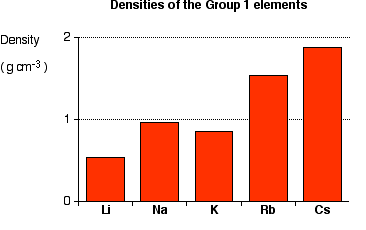
-From top to bottom, density increases
Tuesday, 11 October 2011
Bohr Model
Todays class we had a lesson to learn more about the Bohr Model & deepen our understanding of Niels Bohr's theory.
Bohr's Theory
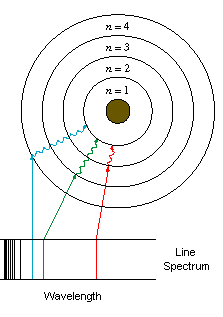
- Electrons exist in orbitals
- When they absorb energy they move to a higher orbital
- As they fall from a higher orbital to a lower one they release energy as a photon of light.

BOHR (1920s)
- Rutherfords model was inherently unstable
protons & electrons should attract eachother
- Matter emits light when it is heated
- Light travels as photons and the energy photons carry depends on their wavelength
seperating white light with a diffraction of wavelengths

Each line represents a photon of light emitted from the excited atom
- Bohr based his model on the energy emitted by different atoms
- Each atom has a specific spectrum of light & each spectrum represents an element
Bohr suggested that electrons occupy shells or orbitals to explain this emission.
We also watched a video on YouTube called the Double Slit experiment by Dr Quantam, which shows particles that go through a slit and form a pattern on a backboard, and then figuring out why there is an interference pattern on the back wall when there are 2 slits made to form a pattern on the backboard.
Bohr's Theory
- Electrons exist in orbitals
- When they absorb energy they move to a higher orbital
- As they fall from a higher orbital to a lower one they release energy as a photon of light.
BOHR (1920s)
- Rutherfords model was inherently unstable
protons & electrons should attract eachother
- Matter emits light when it is heated
- Light travels as photons and the energy photons carry depends on their wavelength
seperating white light with a diffraction of wavelengths

Each line represents a photon of light emitted from the excited atom
- Bohr based his model on the energy emitted by different atoms
- Each atom has a specific spectrum of light & each spectrum represents an element
Bohr suggested that electrons occupy shells or orbitals to explain this emission.
We also watched a video on YouTube called the Double Slit experiment by Dr Quantam, which shows particles that go through a slit and form a pattern on a backboard, and then figuring out why there is an interference pattern on the back wall when there are 2 slits made to form a pattern on the backboard.
Sunday, 25 September 2011
Powers of Ten
Todays class Mr. Doktor started by telling the class about some really interesting news about: Scientist breaking the speed of light in Genova, a finding that could overturn one of Einstein's fundamental laws of the universe. Measurements taken over three years showed neutrinos pumped from CERN near Geneva to Gran Sasso in Italy had arrived 60 nanoseconds quicker than light would have done.
We then had a lesson on Significant Digits & Scientific Notation, and Mr. Doktor gave us a worksheet to practice and review.
- All #'s from 1-9 are significant
- When we add/subtract two #'s we determine the number of significant digits by lining up the numbers and then rounding the decimal.
- When we multiply/divide two #'s we determine the # of significant digits by rounding to the #.
Coverting/Expanding
250,000,000 = 2.5x10^8
2.57x10^4 = 257,000
We then had a lesson on Significant Digits & Scientific Notation, and Mr. Doktor gave us a worksheet to practice and review.
- All #'s from 1-9 are significant
- When we add/subtract two #'s we determine the number of significant digits by lining up the numbers and then rounding the decimal.
- When we multiply/divide two #'s we determine the # of significant digits by rounding to the #.
Coverting/Expanding
250,000,000 = 2.5x10^8
2.57x10^4 = 257,000
Wednesday, 14 September 2011
Balancing Equations!
Todays class we went over our homework, which was a small review of the Lab Safety Rules. Each student then received a green, yellow, and red card to let Mr. Doktor know if we were understanding what he was teaching throughout the lesson. (Green as in I fully understand, Yellow as in I need a few more examples, & Red as in I don't get it at all.)
First we learned what aqueous was (A solution dissolved in liquid) and some other few phase symbols. Ex: Al (s), H2O (l), AgNO3 (aq)
He then listed and explained the Diatomic Molecules: H2, N2, O2, F2, Cl2, Br2, I2
& Polyatomic (many) Molecules: P4, S8
Then Mr. D went through the colummns of the Periodic Table, & explained to us the noble gases, non-metals, and metals. We then took notes on Balancing & Word Equations & were taught an easier way to balance equations without drawing a chart.
An example would be balancing Double Replacement:
2AlCl3 + 3CO2 + 3H2O ---> Al2(CO3)3 + 6HCl
Video taken from kahnacademy.com.
First we learned what aqueous was (A solution dissolved in liquid) and some other few phase symbols. Ex: Al (s), H2O (l), AgNO3 (aq)
He then listed and explained the Diatomic Molecules: H2, N2, O2, F2, Cl2, Br2, I2
& Polyatomic (many) Molecules: P4, S8
Then Mr. D went through the colummns of the Periodic Table, & explained to us the noble gases, non-metals, and metals. We then took notes on Balancing & Word Equations & were taught an easier way to balance equations without drawing a chart.
An example would be balancing Double Replacement:
2AlCl3 + 3CO2 + 3H2O ---> Al2(CO3)3 + 6HCl
Video taken from kahnacademy.com.
Subscribe to:
Posts (Atom)